

There is another dimension to franchise marketing that can
easily be overlooked.
An individual franchise location may operate under a national name, but to the people who live there, it can still be very much a local business.
Franchise owners often live in the communities they serve. They employ local people, support local organizations, build relationships with customers and develop reputations that extend beyond the national brand. Over time, individual locations can develop their own local identity while still benefiting from the recognition, resources and support structure of the larger franchise organization.
That combination is one of the strengths of the franchise model, and marketing should not erase it.
A purely centralized strategy can sometimes treat each location as an interchangeable point on a map. A completely decentralized strategy can lose the advantages of the larger brand. MarketStorm believes the opportunity is to preserve both.
Multi-Location & Franchise
A National Brand Can Still Be a Local Business
Book a Demo Talk to MarketStorm
The national brand creates strength.
The local business creates relevance.
That means local intelligence should account not only for differences in consumer behavior and competition, but also for the position the individual business occupies within its community. A long-established franchisee with strong local recognition may have a very different marketing opportunity from a new owner entering a market where the national brand is known but the local business is not. Another franchisee may have built meaningful community relationships that can strengthen the way the brand is presented locally.
The objective is not to create a different brand for every franchisee.
It is to give the national brand enough flexibility to remain authentic in the communities where its individual businesses actually operate.
National
Brand Recognition
Resources
Support
-
LOCATION A Established Presence Strong local recognition and
loyal customers. -
LOCATION B New Market Building local awareness and
market share. -
LOCATION C Community Ties Deep local relationships and community support.
Local Intelligence Without Losing National Scale
One of MarketStorm’s most important capabilities for multi-location organizations is the ability to support individual markets within a larger strategy. That means the organization doesn’t necessarily have to choose between a single national campaign and dozens or hundreds of disconnected local campaigns.
The larger brand can establish the strategic framework, business objectives, brand standards and shared resources. The MarketStorm Intelligence Engine™ provides a common intelligence architecture. Within that structure, audiences and activation can adapt to the conditions surrounding individual markets and locations.
For franchise organizations, that local layer can include more than differences in consumer behavior. It can recognize that individual franchisees may have different competitive positions, levels of brand maturity and relationships with the communities they serve. This allows the organization to benefit from scale while still respecting what makes individual markets—and individual businesses—different.
It can also address a persistent challenge for franchise organizations: individual franchisees may not have budgets large enough to build sophisticated advertising technology independently. MarketStorm can bring the intelligence and infrastructure of a larger system to the local-market level without requiring the local business to surrender what makes it local.

NATIONAL STRATEGY Shared objectives, brand
standards and resources.

LOCAL ADAPTATION Audiences and activation that
fit each market and location.
The budget may be local. The intelligence doesn’t have to be. And the marketing doesn’t have to lose its local character.
One Brand Doesn’t Mean One Market Story
This becomes particularly important when we think about creative and messaging.
The purpose of local intelligence isn’t simply to decide which consumers receive an advertisement. Understanding the market can also help inform which parts of the brand story are most relevant there.
A national organization may establish the overall brand promise, creative standards and strategic direction while individual markets bring different context to that story. In one community, longevity and local reputation may matter. In another, the franchise may be relatively new and need to establish familiarity. Somewhere else, community involvement, a local owner or a particular market need may provide additional relevance.
ONE NATIONAL BRAND
Same brand. Different local relevance
Shared brand promise | Creative standards | Strategic direction
-
MARKET A
Local
ReputationAn established presence in
the community.
- Long-standing trust
- Local recognition
- Proven results
-
MARKET B
Building
FamiliarityA newer location establishing
awareness.
- Increase awareness
- Highlight key services
- Build local trust
-
MARKET C
Community
InvolvementA local business making
an impact.
- Local partnerships
- Community support
- Relevant local messaging
The brand should still look and feel like a brand. But consistency does not have to mean sameness. The strongest franchise marketing can protect the power of the national brand while preserving the authenticity of the local business.
ProtoSignals™ Can Look Different From Market to Market
Emerging intent isn’t necessarily expressed the same way everywhere.
MarketStorm uses
ProtoSignals™ to describe early behavioral patterns that may indicate a consumer is moving
toward a relevant need, problem, interest or decision. For multi-location organizations, the signals that matter can
vary significantly between markets.
A behavior that strongly indicates emerging intent in one region may be less meaningful somewhere else because the competitive environment, climate, consumer expectations or market conditions are different.
The MarketStorm Intelligence Engine™ allows us to look for those behavioral differences rather than assuming one static audience definition applies equally everywhere.
This is particularly important for organizations operating across very different categories and geographies. Whether the business provides tax services, health and fitness, consumer services, retail products or another multi-location offering, the underlying principle is the same.
MARKET A Warm Climate. Outdoor Living.
- Home Improvement
- Energy Efficiency
- Outdoor Living

MARKET B Cold Weather. Home Readiness.
- Home Maintenance
- Heating Services
- Winter Prep
The brand can scale nationally without assuming consumer intent behaves nationally.

Build the Audience Around the Market, Not Just the ZIP Code
Local advertising is often reduced to geography. Draw a radius around a location, choose a collection of ZIP codes and serve advertising to people inside them. Geography matters, but geography alone doesn’t create relevance.
MarketStorm can combine location with behavioral intelligence to identify consumers within a market who may be demonstrating meaningful signals of emerging intent. This creates a more useful local audience than simply treating everyone within a geographic boundary as equally valuable.
Two people can live a mile apart and have completely different levels of relevance to the advertiser.
Our objective is not simply to reach people who are nearby.
It is to identify the people nearby whose behavior suggests they may matter now.
Local Markets Have Their
Own Competitive Reality
Competition is another reason local intelligence matters. A national competitive strategy can identify the brands that matter across the organization, but individual locations may face entirely different competitive environments. A major national competitor may dominate one market while a strong independent operator controls another. In some locations, the challenge may be winning market share. In others, it may be establishing the brand in the first place.
MarketStorm’s audience and geographic capabilities allow competitive strategy to become more market-specific. That can include identifying audiences demonstrating relevant category intent within a competitor’s market, understanding the competitive environment surrounding individual locations and using behavioral intelligence to focus advertising on consumers who may be open to another option.
For a multi-location organization, competitor conquest does not have to be one national strategy.
-
MARKET A National competitor dominates.
-
MARKET B Strong local independent.
-
MARKET C Brand awareness opportunity.
Competition happens locally.
The intelligence should too.
The Audience Comes First.
The Channel Comes Second.
Individual locations should not have to build separate strategies for CTV, Display, Native,
Streaming Audio
and Digital Out-of-Home. MarketStorm begins with the audience.






Once relevant consumers have been identified and human-verified, Intent Retargeting can allow that audience relationship to continue across available media environments. A consumer may first encounter the brand through Display, later see it through CTV, hear it through Streaming Audio and ultimately search for the nearest location.
Another consumer may follow an entirely different path. The individual media channels perform different jobs, but they are connected by the same underlying audience intelligence.
The channel can change without losing the audience.

JourneyIQ™ Connects Local Intent to the Larger Journey
Consumers don’t move neatly from local advertising to a local website and then directly into a transaction. They may see an ad, search for the national brand, visit a location page, look at reviews, encounter a competitor, return to Google, visit Maps, call a location or simply walk in. JourneyIQ™ reflects that reality.
MarketStorm is designed to continue understanding and influencing relevant audiences as they move between media environments and ultimately toward demand capture. We don’t require the consumer to follow a prescribed funnel, and we don’t assume that the local advertisement will receive the final click.
This is particularly important for multi-location organizations because the consumer may interact with both the national brand and the local location during the same journey. The consumer doesn’t care which marketing budget receives credit.
They experience one brand.
Influence While Preferences Are Still Forming
For many multi-location businesses, Google, Maps and other local discovery environments become extraordinarily important once the consumer is ready to act. MarketStorm works earlier.
Within the Intent & Influence Layer, we have an opportunity to reach consumers while they are still researching, developing preferences and deciding which brands deserve consideration. That makes MarketStorm complementary to local demand-capture strategies.
When the consumer eventually searches for a provider, opens Maps, visits a Business Profile, calls a location or goes directly to a website, the objective is not simply for the brand to appear. The opportunity is for the consumer to already recognize it, consider it or search for it by name.
Demand capture becomes more powerful when preference has already begun to form.
-
01 Research & Discovery Exploring needs and options.
-
02 Early Influence Reaching consumers before decisions are made.
-
03 Recognition & Preference Building familiarity and consideration.
-
04 Ready to Act Search, maps, calls and website visits.
-
05 Stronger Demand Capture The brand is already recognized and considered.
Local Activation. Central Visibility.
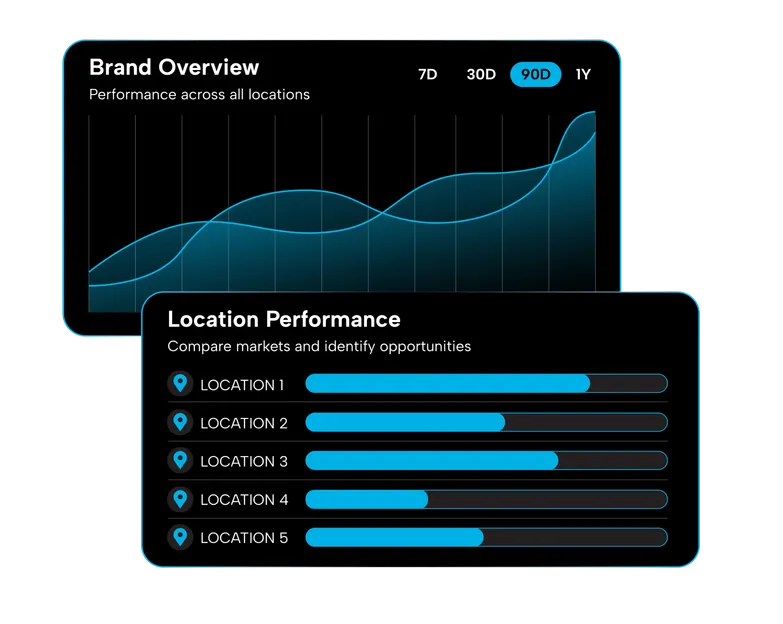
The operational challenge of multi-location marketing isn’t only delivering advertising. Leadership also needs to understand what is happening across the organization.
MarketStorm can support location-level strategies within a larger reporting framework, allowing the organization to examine performance at both the broader brand level and the individual-market level. That distinction matters because averages can hide important information.
A national result may look healthy while individual markets behave very differently. One market may be responding strongly while another requires a different audience strategy. One location may be facing unusually aggressive competition. Another may be seeing changes in consumer behavior that have not yet appeared elsewhere.
Local reporting makes those differences visible. The objective isn’t to create dozens of isolated dashboards and campaigns. It is to give leadership central visibility into a strategy intelligent enough to recognize local variation.
Connecting Digital Influence to Local Footfall
For multi-location organizations with physical locations, the consumer journey often ends somewhere analytics platforms cannot see: through the front door. MarketStorm’s measurement capabilities can include footfall and visitation measurement, helping organizations understand whether consumers exposed to advertising subsequently visit relevant physical locations.
That creates an important connection between digital influence and local business activity.
-

Digital Influence CTV, Native, Display,
DOOH, Audio, Social -

Relevant Audience Behavioral intelligence
identifies consumers -

Real-World Outcomes Store visits, in-store sales, event attendance, location visitation
A consumer may never click an ad or complete a form. They may see CTV, encounter Display, search for the brand later and simply visit the nearest location. A digital-only attribution model can miss much of that journey.
For franchise and multi-location organizations, footfall measurement can provide another view of whether marketing is influencing behavior where it ultimately matters: at the location itself.
Brand Lift Across Markets
MarketStorm can also incorporate brand lift measurement to help organizations understand whether advertising is changing awareness, consideration, preference or other relevant brand measures.
For a multi-location organization, this becomes particularly interesting because brand strength may not be uniform.
An established market and an expansion market may require very different strategies. A market where the brand is already well known may need to reinforce preference or protect share. A newer market may need to establish awareness and consideration before local demand-capture channels can perform at their full potential.
Brand lift provides another way to understand those differences beyond clicks and conversions alone. Together, digital behavior, brand lift and physical visitation can provide a much richer picture of what is happening across individual markets.
-
Awareness Increase brand recognition in
new and existing markets. -
Consideration Grow familiarity and relevance with the right audiences.
-
Preference Build stronger affinity and competitive advantage.

Measurement That Respects How Local Consumers Actually Convert
Local customer journeys are especially difficult to understand through last-click attribution alone.
The final action may be a Google search, Maps visit, phone call, direct website visit, appointment, purchase or physical visit. The system recording that final action may accurately identify where the transaction occurred without explaining what influenced the consumer beforehand.
MarketStorm’s measurement approach looks more broadly.
Depending on the business and available technology,
we can examine media delivery, website behavior, branded search, direct traffic, calls, forms, appointments, CRM
outcomes, brand lift, footfall and other meaningful signals.
We are not trying to claim every conversion.
We are trying to understand what changed in the market and what that can teach us about where to invest next.
Built for Organizations That Need Both Scale and Local Control
Book a Demo Talk to MarketStormThe fundamental marketing challenge for multi-location and franchise organizations is not choosing between national and local. They need both.
They need a consistent brand and a scalable technology architecture. They also need to recognize that every location
operates within a different competitive and behavioral environment. They need centralized visibility without forcing
every market into the same audience. And they need local activation without creating dozens or hundreds of
disconnected marketing strategies. That is where MarketStorm’s model becomes particularly powerful.
The MarketStorm Intelligence Engine™ provides the common architecture. ProtoSignals™ helps
identify emerging intent. Audience Intelligence helps determine who matters within each market. Human verification
strengthens those audiences. Intent Retargeting allows the relationship to continue across channels.
JourneyIQ™ connects the nonlinear consumer journey. Local-resolution intelligence allows the strategy to adapt.
Measurement helps us understand what happens next.
One brand strategy. Local market intelligence. An intelligence system
built to do both.
Good to Know
Programmatic can be complicated. It doesn’t have to be. Here are a few things worth knowing.
-
Can individual franchise locations have different audience strategies?
Yes. That is one of the reasons local-resolution intelligence matters.
A shared national brand does not mean every location faces the same competitors, consumer behavior, seasonality or market conditions. MarketStorm can operate within a common strategic framework while allowing audience intelligence to adapt to individual markets.
-
How do you preserve the local identity of a franchise?
-
Can MarketStorm work with individual locations that have smaller budgets?
-
How is this different from running one national campaign and localizing the geography?